Every minute matters. Every action counts.
Most families who call us after a stroke say a version of the same thing: we didn’t know that’s what it was.
Something seemed off. Mom was unsteady getting out of her chair. Dad’s smile looked crooked, but he waved it away and said he was just tired. So they waited an hour to see if it passed.
That hour matters more than almost anything that happens afterward.
Stroke is a medical emergency measured in minutes. According to the CDC, someone in the United States has a stroke every 40 seconds — more than 795,000 people every year. Most of them survive. But stroke remains a leading cause of serious long-term disability, and it reduces mobility in more than half of survivors aged 65 and older.
Which means the story of a stroke is rarely finished in the emergency room. It is finished at home, over the weeks and months that follow.
This article covers both halves of that story: how to recognize a stroke quickly enough for it to matter, and what a strong recovery at home actually looks like.
Learn the Signs. Save a Life.
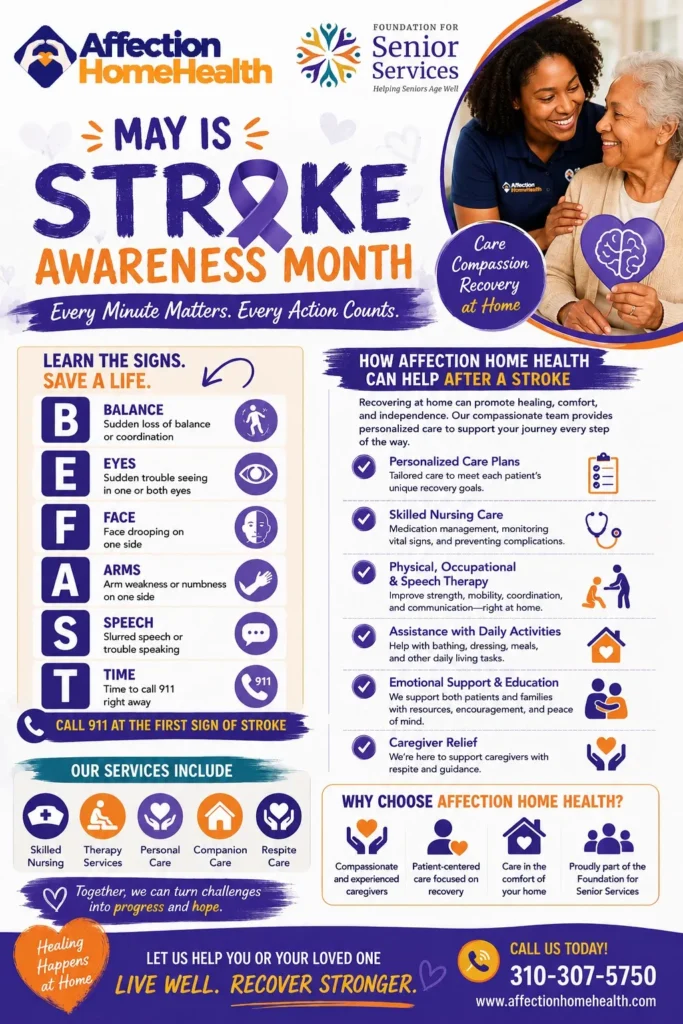
The simplest way to remember the warning signs is BE FAST. Six letters. Six things to look for.
B — Balance
Sudden loss of balance or coordination. A stumble, a lean to one side, or trouble standing that came out of nowhere.
E — Eyes
Sudden trouble seeing in one or both eyes. Blurred vision, double vision, or a loss of vision on one side.
F — Face
Face drooping on one side. Ask them to smile. Does one side of the mouth stay flat?
A — Arms
Arm weakness or numbness on one side. Ask them to raise both arms. Does one drift downward?
S — Speech
Slurred speech or trouble speaking. Ask them to repeat a simple sentence. Do the words come out garbled, or are they struggling to find them?
T — Time
Time to call 911 right away. Not later. Not after a nap. Right away.
You do not need all six signs. One is enough to call.
Two More Signs Worth Knowing
BE FAST covers the six most recognizable warning signs, and it is the version worth committing to memory. But the American Stroke Association lists two more that families routinely miss, because neither one looks dramatic:
- Sudden severe headache with no known cause — often described afterward as the worst headache of a person’s life.
- Sudden confusion — trouble understanding what is being said, or disorientation that arrives out of nowhere.
The second is especially easy to explain away in an older adult, because families assume it’s tiredness or ordinary forgetfulness. Sudden is the word that matters. If confusion appears over minutes rather than months, treat it as a stroke until a doctor tells you otherwise.
Three Things Families Get Wrong in the First Ten Minutes
Good intentions cause most of the delay. These are the three mistakes we see most often.
1. Driving them to the hospital yourself
It feels faster. It usually isn’t, and it’s rarely better. Paramedics begin assessment on the way, can route to a hospital equipped for stroke care, and alert the emergency department before you arrive — so the team is waiting when the doors open. Call 911.
2. Waiting to see if it passes
Some stroke symptoms fade within minutes. That is not the all-clear it feels like. It may have been a transient ischemic attack — a warning sign that a larger stroke could follow, sometimes within days. A TIA is still a 911 call and still needs to be evaluated the same day.
3. Not noting the time
Write down, or simply remember, the moment symptoms started. Some of the most effective stroke treatments are only available within a limited window from symptom onset, and the clinical team will ask you for that time. If your loved one woke up with symptoms, the answer they need is the last time you saw them completely normal.
Call 911 at the first sign of a stroke.
The Second Half: Coming Home
The hospital stabilizes. Home is where recovery happens.
Discharge day is often the moment families feel the ground shift. The monitors are gone, the call button is gone, and a person who was independent three weeks ago now needs help standing up. Medication lists have doubled. Nobody in the house has done this before.
This is exactly what home health care exists for.
Home health is skilled, medical care delivered in the home under a physician’s plan of care — nursing, physical therapy, occupational therapy, and speech therapy, brought to the living room instead of the clinic. For patients recovering from a stroke, it does two jobs at once: it drives functional recovery, and it prevents the complications that send people back to the hospital.
Because this care is medically necessary and physician-ordered, it is typically covered by Medicare Part A or Part B for patients who qualify, generally at no out-of-pocket cost for the home health services themselves. Affection Home Health is a Medicare-certified agency, and we also work with Medi-Cal, Anthem Blue Cross, Humana, TriCare, myNexus, and other plans. If you are unsure what your coverage includes, call us — checking is free and takes one phone call.
How Affection Home Health Supports Stroke Recovery
Every recovery is different, which is why every plan of care we write starts with the patient, not a template.
- A personalized plan of care. Built around this patient’s deficits, goals, home layout, and family situation, and coordinated directly with their physician.
- Skilled nursing. Medication management after a stroke is genuinely complicated — blood thinners, blood pressure medication, and cholesterol medication all at once, often new. Our nurses manage the regimen, monitor vital signs, watch for warning signs of a second stroke, and provide wound, catheter, and diabetic care where needed.
- Physical, occupational, and speech therapy. Physical therapy rebuilds strength, balance, and safe walking. Occupational therapy restores the everyday things — dressing, bathing, cooking, getting in and out of a chair. Speech-language pathology addresses speech, language, and swallowing difficulty, which is common after a stroke and carries real risks if it goes unaddressed.
- Certified home health aides. Hands-on help with bathing, dressing, meals, and the other daily tasks that turn difficult after a stroke — provided under the supervision of a registered nurse.
- Emotional support and education. A stroke frightens the patient, and it frightens everyone who loves them in a different way. Our medical social workers connect families to benefits, community resources, and equipment. The rest of the team handles the harder part: encouragement on the difficult days, and the peace of mind that comes from knowing someone who understands this will be back tomorrow.
- Support for the caregiver. The spouse or adult child holding all of this together needs guidance and relief as much as the patient needs therapy. We teach safe transfers, medication routines, and the warning signs to watch for — so families feel capable instead of terrified.
We coordinate closely with physicians, case managers, and hospital discharge planners throughout, with one goal that sits underneath all the others: keep the patient safe at home and out of the hospital.
Why Families Choose Affection Home Health
- Compassionate, experienced caregivers. Our guiding philosophy is built on a single word — affection — and it isn’t decoration. It is the standard we hire against, train against, and hold ourselves to in someone else’s home.
- Care focused on recovery, not just maintenance. Every plan of care is written toward a goal the patient actually wants. Walking to the mailbox. Holding a grandchild without help. Cooking dinner again.
- Care in the comfort of your own home. Familiar surroundings, your own bed, your own schedule, and the people you love nearby. For most stroke patients, that combination does more for recovery than any facility can.
- An accredited, around-the-clock team. Affection Home Health is Medicare certified and ACHC accredited, available 24 hours a day, and in constant communication with your physician and care team.
Care. Compassion. Recovery — at home.
Preventing the Next One
Roughly one in four stroke survivors will have another stroke. That statistic is sobering, but it is also the most actionable number in this article, because secondary prevention is largely about consistency — and consistency is exactly what skilled care at home is built to deliver.
High blood pressure, high cholesterol, diabetes, smoking, and obesity are among the leading contributors to stroke risk. Managing them is a daily discipline, not a one-time fix: taking medication exactly as prescribed, monitoring blood pressure, keeping follow-up appointments, and adapting diet and activity in a way the patient can actually sustain.
A nurse in the home sees what a fifteen-minute office visit cannot. That is often what makes the difference.
We Serve Families Across Southern California
Affection Home Health is based in Manhattan Beach and provides skilled home health care across Greater Los Angeles, Orange County, Santa Clarita, Riverside, and San Bernardino. We are ACHC accredited, Medicare certified, and available 24 hours a day. You can meet our clinical team here.
If someone you love is coming home after a stroke — or if you simply want to understand what support is available before you need it — we would be glad to talk it through with you.
Call 310-307-5750 or contact us here. There is no cost to ask.
Together, we can turn challenges into progress and hope.
Healing happens at home. Let us help you or your loved one live well and recover stronger.
This article is provided for general educational purposes and does not constitute medical advice, diagnosis, or treatment. If you suspect a stroke, call 911 immediately. Always consult a qualified healthcare provider about your individual circumstances. Sources: Centers for Disease Control and Prevention; American Stroke Association.