

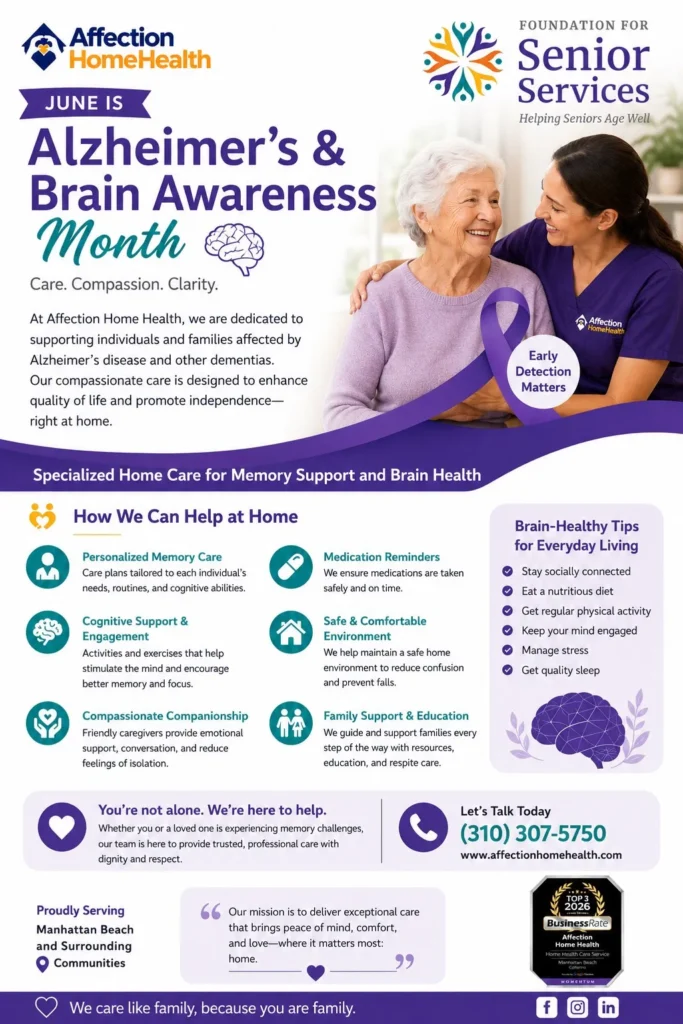
Care. Compassion. Clarity.
It rarely starts with a dramatic moment. It starts with a question nobody quite says out loud.
Mom told the same story twice at dinner. Dad paid the water bill three times this month. Your aunt, who has driven the same route to church for thirty years, called to say she wasn’t sure where she was.
Any one of those could be nothing. Everyone forgets things. Everyone gets turned around occasionally. That is exactly what makes this so difficult — the line between ordinary aging and something worth investigating is genuinely blurry, and families can spend months on the wrong side of it, watching and worrying and saying nothing to each other.
This article is meant to make that line clearer. June is Alzheimer’s and Brain Awareness Month, but none of what follows is seasonal — these are worth knowing whenever the question first occurs to you.
One note on language before we begin. Alzheimer’s is the most common cause of dementia, but it is not the only one. Vascular dementia, Lewy body dementia, frontotemporal dementia, and mixed forms together account for a substantial share of cases, and the warning signs below apply broadly across them. If your family is facing a diagnosis that isn’t Alzheimer’s, this article is still for you.
The 10 Early Signs
The Alzheimer’s Association identifies ten warning signs of Alzheimer’s and other dementias. What makes them useful isn’t the list on its own — it’s the comparison. For each one, there is a version that is a normal part of getting older, and a version that isn’t.
1. Memory loss that disrupts daily life
Forgetting recently learned information. Asking the same question repeatedly. Leaning on notes, reminders, and family members for things they always handled themselves.
Ordinary aging: forgetting a name or an appointment, then remembering it later.
2. Trouble planning or solving problems
Difficulty following a familiar recipe, keeping track of monthly bills, or concentrating on anything with several steps. Familiar tasks take far longer than they used to.
Ordinary aging: the occasional error balancing the checkbook.
3. Difficulty completing familiar tasks
Trouble with things done a thousand times before — driving to a familiar destination, operating the microwave, following the rules of a favorite card game.
Ordinary aging: needing help with the settings on a new phone.
4. Confusion about time or place
Losing track of dates, seasons, and the passage of time. Forgetting where they are, or how they got there.
Ordinary aging: forgetting what day it is, then working it out a moment later.
5. Trouble with vision and spatial relationships
Difficulty reading, judging distance, or telling colors and contrast apart — which can affect balance and make driving unsafe. For some people, this is the first sign anyone notices.
Ordinary aging: vision changes caused by cataracts.
6. New problems with words
Struggling to follow or join a conversation. Stopping mid-sentence with no idea how to continue. Repeating themselves, or calling familiar objects by the wrong name.
Ordinary aging: occasionally hunting for the right word.
7. Misplacing things and being unable to retrace steps
Putting things in unusual places, and losing the ability to work backwards to find them. Over time this can turn into accusations that someone is stealing.
Ordinary aging: mislaying the keys and finding them after a search.
8. Decreased judgment
Noticeable changes in decision-making. Falling for phone or mail scams, giving away large sums of money, or a marked decline in grooming and personal hygiene.
Ordinary aging: making a poor decision now and then.
9. Withdrawal from work or social life
Pulling back from hobbies, projects, church, and social occasions — sometimes because keeping up with a conversation has quietly become exhausting.
Ordinary aging: feeling weary of obligations from time to time.
10. Changes in mood and personality
Becoming confused, suspicious, anxious, fearful, or withdrawn. Easily upset in unfamiliar surroundings, or when a routine is broken.
Ordinary aging: having set ways of doing things, and getting irritable when they’re disrupted.
One sign is worth a conversation. Several are worth an appointment.
Why Early Detection Matters
Families often delay because they are afraid of the answer. It’s worth knowing that the answer is not always the one they fear.
Not all memory loss is Alzheimer’s — and some causes are reversible. Thyroid disorders, vitamin B12 deficiency, medication interactions, depression, sleep apnea, and infections (urinary tract infections in particular, which in older adults can cause sudden confusion) can all produce symptoms that look like dementia. Several of these are straightforward to treat. An evaluation may find something fixable, and families who wait never find out.
If it is dementia, early matters. An early and accurate diagnosis opens the door to treatments that may ease symptoms and help preserve independence for longer. It also opens the door to support services, clinical trials, and community programs that are far harder to arrange in a crisis.
It buys time to plan together. Legal documents, financial decisions, and care preferences are far better decided with the person than for them. Early diagnosis means your loved one can still be the author of their own plan.
It ends the guessing. For many families, the not-knowing is its own weight. A diagnosis is hard, but it is something you can act on.
How to Start the Conversation
This is the part most people find hardest, so a few practical notes.
- Pick a calm, private moment. Not a holiday table. Not immediately after an incident, when everyone is upset.
- Lead with concern, not evidence. “I’ve noticed you seem frustrated lately, and I want to help” lands very differently from a list of everything they’ve gotten wrong this month.
- Expect resistance, and don’t take it personally. Defensiveness in this conversation is almost always fear wearing a different face. Your loved one has very likely noticed the changes long before you did.
- Offer to go with them. Sitting in the waiting room is a smaller ask than going alone.
- If they refuse, you can still call their doctor. Privacy rules limit what a physician can tell you, but nothing stops you from sharing what you’ve observed with them. That information often changes what happens at the next appointment.
You can also call the Alzheimer’s Association’s free 24/7 Helpline at 800.272.3900 to talk through your situation with someone who does this every day. It costs nothing, and you don’t need a diagnosis to call.
Living Well at Home with Memory Loss
A diagnosis is not the end of independence. With the right support in place, many people live safely and comfortably at home for years — and familiar surroundings do real work here. Routine, a known layout, and the presence of family reduce the confusion and agitation that unfamiliar environments provoke.
At Affection Home Health, we support individuals and families affected by Alzheimer’s disease and other dementias. Everything we do is measured against two questions: does this improve quality of life, and does this protect independence for as long as possible? Care that fails both tests isn’t care — it’s supervision.
Our memory support is built around what this particular person needs.
- Personalized memory care. A care plan built around the individual’s routines, abilities, and preferences — not a generic dementia template. What they like to eat, when they like to wake, what music settles them.
- Medication reminders. Missed and doubled doses are one of the most common and most preventable problems in memory care. We help make sure medications are taken safely and on schedule.
- Cognitive support and engagement. Activities and exercises that keep the mind active and give the day a shape. Conversation, familiar tasks, music, puzzles, and photographs — meaningful engagement, not busywork.
- A safe and comfortable environment. Reducing the clutter, lighting, and layout problems that cause confusion and falls, and building the daily routine that helps someone with memory loss feel oriented and calm.
- Compassionate companionship. Isolation accelerates decline and deepens depression. A familiar, friendly presence — someone who listens, who knows the stories, who is simply there — is genuinely part of the care.
- Family support and education. We teach families how to respond to repetition, agitation, and sundowning without escalating; how to make the home safer; and what to expect next. And we provide respite, so the person doing the caring gets to rest.
Six Habits That Support Brain Health
None of these prevent Alzheimer’s. All of them support brain health at any age, and they are worth building into a daily routine well before anyone is worried.
- Stay socially connected. Isolation is a genuine risk factor, not just a sadness.
- Eat a nutritious diet. What’s good for the heart is generally good for the brain.
- Get regular physical activity. Movement improves blood flow to the brain. A daily walk counts.
- Keep the mind engaged. Reading, puzzles, music, learning something new, meaningful conversation.
- Manage stress. Chronic stress affects memory and sleep, and both affect thinking.
- Protect sleep. Quality sleep is when the brain does its housekeeping. Untreated sleep apnea is worth investigating.
Managing blood pressure, cholesterol, and diabetes belongs on this list too. Vascular health and brain health are closely linked — which is also why stroke is a risk factor for dementia. If a stroke is part of your family’s story, our guide to stroke warning signs and recovery at home covers that connection.
Who Pays for Memory Care at Home?
Most families get a confusing answer to this question, so here is a straight one.
What Medicare generally covers. Medicare covers medical care related to dementia: doctor visits, diagnostic testing, cognitive assessments, and prescriptions under Part D. It also covers skilled home health — intermittent nursing, physical therapy, occupational therapy, and speech therapy — for patients who are homebound and have a physician-ordered skilled need. After a hospital stay, a fall, or a new medical complication, that benefit often applies.
What Medicare generally does not cover. Ongoing supervision, companionship, help with bathing and dressing, and long-term day-to-day support are classed as custodial care, and Original Medicare does not pay for them. This surprises almost every family, usually at the worst possible moment. A dementia diagnosis on its own does not qualify someone for ongoing covered care.
What families actually use. In practice, most people combine sources: Medicare for the skilled episodes, and private pay, long-term care insurance, veterans’ benefits, or Medi-Cal programs such as In-Home Supportive Services for the daily support. Some Medicare Advantage plans include supplemental in-home benefits that Original Medicare does not.
We would rather tell you this plainly than let you discover it later. Call us and we will walk through your specific situation, what is likely to be covered, and what the realistic options are. There is no charge for that conversation, and no obligation attached to it.
You’re Not Alone. We’re Here to Help.
Whether you or someone you love is facing memory challenges, our team provides trusted, professional care with dignity and respect. Affection Home Health proudly serves Manhattan Beach and the surrounding communities, along with Greater Los Angeles, Orange County, Santa Clarita, Riverside, and San Bernardino.
Let’s talk today. Call 310-307-5750 or contact us here.
Our mission is to deliver exceptional care that brings peace of mind, comfort, and love — where it matters most: home.
We care like family, because you are family.
This article is provided for general educational purposes and does not constitute medical advice, diagnosis, or treatment. Memory concerns should always be evaluated by a qualified healthcare provider. Coverage details vary by plan and individual circumstances; confirm your benefits with Medicare or your insurer. Warning signs adapted from the Alzheimer’s Association’s 10 Early Signs and Symptoms of Alzheimer’s Disease.